Event Description
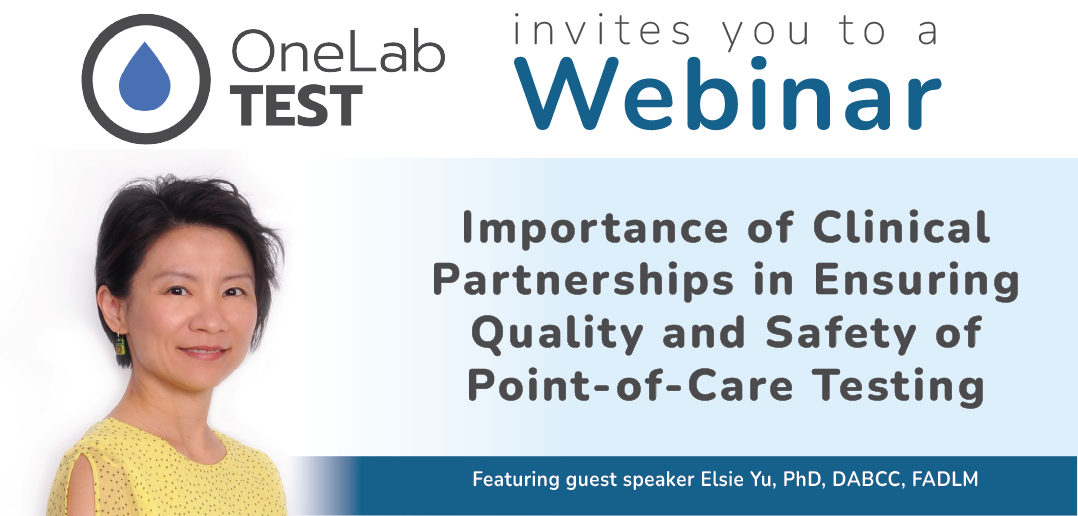
As point-of-care testing continues to expand in hospitals, clinics, and at-home settings, the concept of clinical partnership takes on a new meaning. In this webinar, we will discuss the partnership between laboratory and clinical practitioners, as well as the inclusion of patients (consumers).
The goals of this webinar are:
- To emphasize the importance of laboratory and testing professionals building and sustaining strong relationships with their partners.
- To emphasize how these relationships ensure the laboratory and testing communities keep prioritizing quality and safety.
Event Objectives
After completing this training, participants will be able to:
- Evaluate point-of-care testing needs by considering ease of use, clinical need, and cost- effectiveness.
- Develop a collaborative framework within the healthcare system that encourages partnership among clinical teams, patients, and laboratory professionals.
- Develop and implement processes to optimize test utilization, improve patient safety, and ensure quality testing.
Event Media
Importance of Clinical Partnerships in Ensuring Quality Safety of Point-of-Care-Testing
OK everyone, we can go ahead and get started.
My name is Sophie Maria, and I'm a consultant with Guidehouse supporting CDC’s OneLab initiative.
A couple of notes about the webinar before we dive in. If you are experiencing any technical issues during the webinar, please feel free to e-mail the OneLab inbox for support at onelab@cdc.gov.
If you have questions throughout the session, please insert them into the Q&A function below, which is represented by the Q&A icon. We'll conduct a Q&A session at the end of this presentation where we will review questions and do our best to provide answers.
Please note that I've posted the link to the live captions in the chat. However, please ensure that both the captions window and this webinar window remain open if you choose to use them.
Today we'll start by discussing new OneLab resources, then we'll introduce today's presenter. We'll have about a 10-minute Q&A session at the end where we'll review questions and do our best to answer. Then today's session will end with a discussion of upcoming events.
For today's webinar, we will be leaving the chat box open for your engagement. When you're using the chat box, please adhere to the established rules of engagement. You can feel free to use the chat to connect with others by reacting to what you're hearing, sharing your experiences, and asking questions to fellow participants.
If you have a question for the presenter, please use the Q&A function, not the chat. Additionally, please engage with respect and professionalism. Any inappropriate language, improper conduct, or discrimination may result in removal from the webinar.
If a moderator provides direction regarding chat behavior, please comply accordingly. Lastly, please notify moderators if you experience technical difficulties or observe any disruptive behavior.
I will now turn it over to our OneLab lead, Alicia Branch, to share some of our new and relevant resources.
Thank you, Sophie. Before we start the main presentation, I'd like to take a moment to share the free educational materials from Ready? Set? Test!, a helpful OneLab resource related to today's topic.
The Ready? Set? Test! resources include a booklet, a self-assessment checklist, and an e-learning course, which are valuable tools for training healthcare professionals or individuals without a healthcare background who conduct patient testing under a CLIA certificate of waiver.
Now the booklet includes forms and logs that can be used regardless of the point-of-care, testing methods, or the location where tests are conducted, as well as a self-assessment checklist for best testing practices. The booklet and the checklist can be downloaded or obtained in hard copy by clicking the link in the chat.
The e-learning course is a scenario-based training that explains the steps of the waived testing process. After completing the course, 1.5 contact hours of PACE credit can be earned. You can access the course by clicking the link in the chat.
Next slide, please.
I will read the CDC external speaker disclaimer statement and then introduce today's speaker. Slide decks may contain presentation material from panelists who are not affiliated with CDC. Presentation content from external panelists may not necessarily reflect CDC's official position on the topics covered.
Next slide, please.
I am excited to introduce our presenter, Dr. Elsie Yu. She is board certified by the American Board of Clinical Chemistry and serves as the medical director overseeing clinical chemistry, immunology, toxicology, point-of-care testing, and clinical pathology informatics at Geisinger Health Systems. She is also a professor of pathology at Geisinger's College of Health Sciences. In 2016, she was named to the 40 under 40 top five by the American Society of Clinical Pathology. Her primary interest is improving laboratory testing utilization and operational efficiency. She often speaks on point-of-care testing and is eager to share her insights on the importance of clinical partnerships and ensuring quality and safety in point-of-care testing.
Our OneLab test presenter for today is Dr. Elsie Yu. Over to you, Elsie.
Thank you for the introduction. Let me switch over to share my slide.
All right, can you guys see my slide? Yes, we can see it. Awesome. Again, thank you for the introduction and invitation to speak with you today. This is a topic that I'm truly passionate about, and hopefully, we can have some good discussion at the end of the presentation.
I don't have anything to disclose. I'll be mentioning a few point-of-care testing devices throughout my presentation, but I don't have any financial support from them.
In my talk today, I will briefly talk about
who laboratories partner with, including nurses, medical doctors, pharmacists, and respiratory therapists. Towards the end, I will talk about a slightly different idea about thinking of patients as someone we partner with directly. I will also go through what my team at Geisinger does in terms of point-of-care testing. I think the services we provide really help strengthen that partnership.
Throughout the presentation, I'll focus on two general topics. One is how partnerships help with test selection and the other is the clinical testing protocol.
First, a little bit about where I work. Geisinger Health System is in central Pennsylvania. We provide a continuum of healthcare to about 4 million people in 45 Pennsylvania counties. We have 10 hospital campuses and about 160 primary and specialty clinics.
Here's a map to help you see where we are. Showing you here is the state, Pennsylvania. The dark green is our primary service area, and the red are the 10 hospitals I mentioned. Throughout the green and these light green colors, we have the 160 specialty and primary clinics that serve our patients.
Now, let's zoom in on point-of-care testing. Throughout the entire hospital system we currently have 8,400 point-of-care testing operators, 1,000 of whom also perform non-waived testing, and 58 of them perform provider-performed microscopy. Our test volume is about 1.4 million a year, of which about 800,000 are glucose tests and about 47,000 are i-STAT testing. Besides i-STAT and glucose meters, we also have Clinitek to do
urinalysis testing and CoaguChek to do PT/INR, DCA Vantage do HbA 1c, and a few AVOXimeter HemoCue and CardioChek lipid tests.
We also have manual tests in our system. They include gastroccult, hemoccult mono tests, pH paper for fluid testing, strep A, urine drug screens, and urine pregnancy tests.
Now, let's focus more on the test selection and management part of things.
Let's go through this looking at a few cases.
In many of my clinics, we have the strep A test available for physicians to use. One of the clinicians was trying to increase the sensitivity of the test by increasing the incubation time.
The problem with this is that first of all we don't know if increasing the incubation time is going to really help
improve the test accuracy. In theory, it sounds like a good idea, but if they wanted to do that, we would have to do a validation study. A complication of this is is that if we make changes to the test system instructions, the test will no longer be considered waived tests. I will talk about
this a little later. If we change a test from waived to non-waived or laboratory-developed tests (LDT), there is a lot of regulatory work involved. You can't just change a test, but the provider doesn't know.
Now, let's look at the second case. In this case, the nurses wanted to perform an iSTAT test but didn't have a plain syringe. She had a saline syringe that she found in her pocket. To save time, she expelled the saline in the syringe and then drew up the blood samples for Chem8 testing.
This is your first poll question: What do you think happened to the lab results? I hope you can see the poll that should be showing up on your screen.
The poll should be up now. I don't know if I can see the results. It looks like 82% chose option C. I think I'm talking to a lot of lab people here, so you all got the right answer, which is great.
Through these two examples, you can see that the provider may have the best intentions, which is they want to get the results done faster and ensure accuracy, as in the first case—but they don't fully understand the implications of what they do
and realize that even a small deviation in testing procedures can have a negative impact.
Through lab partnerships, I believe it is key to ensuring good lab results and preventing potential serious events. When we see these types of issues, we provide additional training and education.
Let's look at two more cases. Many of you may know that there's a new traumatic brain injury test available with iSTAT Alinity which helps rule out intracerebral hemorrhage. When our providers in EMS medicine know about it, they were very excited and wanted to implement it on the field to triage patients and save time by bringing patients to the ED.
But there are a couple of problems with that. This may just be a Pennsylvania thing,
but because the test is non-waived in Pennsylvania, DOH actually doesn't allow us to use non-waived tests outside of a healthcare facility. From a regulatory standpoint, it would be very difficult to implement it in the way they want.
This is your second poll question, case 4.
Similar to that, a sales rep from Company Y, visited a clinic, dropped off a glucose meter and test strips for trial. My question to you is if they can use it to perform patient testing. I'll give people a minute to do the poll.
I can see the results coming through. I see that no one picked option A, which is great. Again, I can see that I must be talking to all the lab people.
Even though it seems like a good idea to use it because it's free, from a regulatory standpoint, the biggest issue is that the glucose meter dropped off is not cleared for hospital use.
The FDA has very clear guidelines on whether a device is cleared for home use or hospital use from a point-of-care testing standpoint. Another concern we typically have from a lab standpoint is we want to make sure that
we know if the test result is accurate before we use it for patients. Another is about infection control.
One reason that home-use devices and hospital devices are very different is that with the home-use devices you don't have to worry too much about infection control because it's not going to be used by multiple people.
In a hospital setting, one device may be used by multiple patients, so we always need to have infection control protocols in place.
In these last two cases, I wanted to highlight the distinction between waived tests and non-waived tests. From an FDA standpoint, typically when it's waived, the test is considered simple with minimal chances of error, so as long as the manufacturer's instructions are followed to perform testing. Non-waived tests typically
require more advanced training.
From an oversight standpoint, waived testing are a lot easier to manage, but for non-waived there a lot more regulations that we need to follow. One of the things for non lab people who may be on the call is that
lab regulation is complicated. There are federal regulations like CLIA and FDA regulations that we have to folllow, there's also state regulations, like DOH, like the one I was talking about, the new TBI test.
Pennsylvania may be different from your state. On top of that, the accreditation bodies like CAP or the Joint Commission can be stricter in how they interpret those lab regulations. So it's really not all that easy to make sure we are compliant, even though I have been doing this
for close to 15 years at this point. There are often times
that I have to go back to look at the regulations word to word to ensure I haven't misinterpreted them.
Finally, on top of the lab regulation, that different highly recommended guideline, the one that all you probably know on this call is the CLSI guideline.
Even though they're not considered regulation, often times they're so highly, highly recommended that we do want to follow them.
So one of the things that the lab does is that we help ensure regulatory compliance.
The two things that I was talking about whether a test is waived or non-waived is one of the first things that I always look at when I'm thinking about point-of-care testing because it also dictates personnel qualification as in who can be qualified to run the test or who can be the supervisor or lab director.
So all those are complicated. And on top of that
the lab also makes sure that we have a good SOP in place which have very clear guidance on how often quality control needed to be done or calibration is needed, as well as training and resource reporting to make sure we are compliant as well as being able to perform the tests as accurate as we can be.
One of the questions that actually get asked pretty frequently is whether waived testing requires a lab license.
Most of you again on this call probably know, but based on the regulation, yes, even waived testing does require a clear license in order to perform testing.
So in our health system, even just with all the certificates, we have close to 100 of them and we need to closely monitor the certificate for expiration dates and manage payment to make sure we renew them in a timely basis.
That's one of the things that my point-of-care testing team actually do.
So that we can make sure the license application is correct as well as not expired. Because of all the testing locations
we also coordinate with DOH to make sure the inspections are done.
And of course we help our provider to understand the regulations so that we can be compliant.
And other things that my team does is to have good standard operating procedures.
We develop them as in we write them and have them review it as well as we make sure they annually review and update it.
And if there's any need for changes or make it more clear, we also make that changes. Quality control.
Our team reviews them monthly to make sure that they are all completed and there was no quality issues.
We also perform reagent verification when we get new lots of reagents, and we also make sure that device is set up in such a way that when QC is out, it will be shown on the device so the user knows that the quality metrics is not being met.
Our team also helps manage patient testing for devices that can be interfaced, we work with IT to make sure that the device is interfaced and the results get filed in correctly.
And for tests that doesn't have that capability, we also work with IT to set them up in our EHR, so the provider can do manual added on the results entry field to document the results properly.
And I think a lot of our users don't fully understand setting up device interface.
Often it's not that simple and requires a lot of work.
And even after the initial setup, often time there's a lot of maintenance involved and software upgrades.
My team also make sure those get done in all our devices.
Related to that is network connectivity.
If there's ever an issue with which actually happened relatively frequently, our team helps troubleshoot the issues and work with IT to resolve it.
We also have a good record in our middleware that store all the patients information, all the patients data, the ID together with the result.
And if you know the users scan the wrong patient's band and have the wrong result file to the patient's chart,
we also make those corrections. For the equipment,
there's a lot of upkeep on that.
We provide all the equipment maintenance for the users and if it's broken or doesn't work or malfunctions, we also have them replaced if needed.
There's a lot of inventory management that occurs for point of care testing.
Some of it includes like the reagent that we talked about but it also includes making sure that nothing is expired.
So my team does floor checks on a monthly basis and they also check the quality of the supplies like I mentioned earlier
and all the inventory actually, all the reagent actually, come into my central team.
And then when the floor needs additional order, they order from us so we can have a better control of the quality.
Training and competency. We provide training materials and once training is completed,
we will give the user a batch which have their point-of-care testing specific ID number on it.
And we track to make sure that all our operators have their competency done in a timely manner.
And if something you know they didn't do something right,
we'll also provide remedial training.
On safety. Like the infection control that I was talking about with the glucose meter
we developed those safety policies and audits and then we also implemented plans if there were any issues.
So all those we have provided a lot of values to our users to enhance test accuracy and performance as well as test selection.
What I wanted to shift gears a little bit is about clinical utilization.
And in this part of it, I'll focus on talking about
all tests inherently have test limitations.
It's about understanding the test limitations so that we can prevent errors and make sure it is being used in the right group of patients.
And then also talk about the need to target a specific group of population if we really want to drive outcome.
One of the examples that I talk a lot about is urine drug test; showing you is one of the drug test cup that you can find in many companies.
These tests, they are what they are.
It's not that the tests are bad, it's just that the results are considered presumptive.
What I meant is that they could have false positive and or false negative. If not interpreted carefully it could have really bad outcome.
For example, we strongly advise against using this test for pre employment drug screen
and the reason is that if someone have a false positive on this drug cup,
it would cause someone to lose a job or interview.
And similarly for pain management, it is just as big of a problem on the idea of
using testing for pain management is to make sure the patient is taking the drug that they're supposed to be taking.
But often times these cups may not screen for the drug that you may be interested.
For example, if your patient is on Ritalin, well, there's no cup that screens for Ritalin.
So you come up with negative, and if you misinterpret those results, sometimes it could lead to wrongful dismissal of patients from their treatment program.
Another test that we use is the PTI/INR point-of-care testing.
There are multiple devices that can do this now.
But in our system, we limited the test to our medication therapy management pharmacist.
So it's a much smaller group to use to manage a patient who takes Warfarin.
And the reason that we limit it to a small group of users was because there is some discordance between the PT/INR
on the device compared to the core lab results.
So if they are not used to seeing the result, that is a possibility of misinterpreting the test results
and then cause the patient to have the wrong dosage adjustment for that Warfarin.
So these pharmacists were trained to understand that the results are only comparable within 20 to 25%, which is quite a big range.
They are also more in tune with what the results mean and would ask the lab to recheck if needed.
One of the questions that often come up is that sometimes the ED would be thinking that, can we use this to check for a stroke patient.
The answer is no.
As far as I'm, I know all the PT/INR
point-of-care devices out there are only clear to be used for patients that are on Warfarin only.
So the two examples that I talk about, the main point is that I want to come across, is that there are test limitations on any of these devices, and it may not always be obvious to our providers.
So the lab really should communicate the limitations to the provider when selecting test methods and as well as during training to minimize the issues.
The next things I want to talk about is that often time we think about when there's a test, people must be using it since they asked for us to improve outcome.
And that's actually not really true.
And I'll give I'll talk about this example about our experience in launching the HBA one CDCA test.
And I'll talk about this example about our experience in launching the HbA1c DCA test.
We have a really good collaborator with the Diabetes Care Team as well as the Geisinger Health Plan in the system to launch this project.
And the initial goal of the project is really to target patients with HbA1c greater than 9.
It takes a long time to get the instrument set up, interfaced and all that.
But even after we have it finally set up, we have seen that the test wasn't being used as often as we thought.
And in addition, we didn't really see a clinical impact to the patient as in the number of patients who have high HbA1c remain high.
So we work on it and form a multi-disciplinary team which includes the nutritionist, pharmacist, OPS people, the clinic staff and the case manager.
What this team does is that they have a list of patients with high HbA1c and each week this team will discuss their recommendations for the treatment plan,
follow-up plan for these patients.
And the recommendations would then be reviewed with the clinical staff and providers during daily huddle.
And I think this daily huddle is important because that also help the clinic providers make sure that the A1c testing is done and with that the provider was able to provide recommendations to the patient.
In addition, these patients are being followed up every 30 days with a member in the care team.
So the result was pretty dramatic.
With the launch of that collaborative effort, we were able to see a reduction of patients with high HBA 1C.
Showing you in the graph example of free clinic the Y axis is showing you the percent of patient with HbA1c greater than 9.
So you can see that in all cases we were able to bring that percentage down and you can see that the result was really dramatic in clinic number 2 where it was reduced from 54.3% to 26.3%.
So it is really important to have a process in place in particular to look to see what obstacle was there and how to overcome it.
And also to be able to track the clinical effectiveness with data.
I think that really helps our users to see how their effort has played out.
And with the partnership between lab and providers, I really think that we were able to have an integrated and coordinated care model, which improves operation and regulatory compliance as well as enhanced clinical utility of lab testing, ensures accountability for quality care and cause and ultimately that improve patient experience and care.
So, far we have talked about patients in a little bit indirect manner, even though the angle is always to improve their care.
But I want to shift gears a little bit to talk about patients as more a direct partner.
At-home testing probably is not foreign to any of you.
Many people have used various at-home testing.
Many at-home tests have been in the market for a very long time.
For example, pregnancy test, glucose test, and fecal occult blood testing.
In 2007 the world kind of changed when
23andMe or ancestry.com arrived on the scene.
Those are the first companies that do genetic testing and offer at-home testing.
2012 HIV test was another hallmark as well as many other tests like ovulation test kit, drug abuse test.
And now you can find everything including allergy testing, fitness tests, and of course no one will
forget about COVID-19 and all the COVID testing that was available for us to use.
One of the things that's important to really think about is that not all the at home testings are equal.
This is a funny article that I found from 2018.
The headline says some genetic tests apparently can't tell if you're a dog or a human.
So apparently what this news station did is that they sent one reporter's DNA to a handful of home DNA tests to compare the result.
And in addition to sending the reporter's DNA, they also sent the DNA from a lab retriever.
While most companies were able to figure out that the lab retriever samples were not readable,
one of them that didn't seem to notice that and had A 7 page report praising how good the cardiac output and muscle force is of the dog.
So hopefully this highlights that they are not all the same.
While this seems to be funny, this other article that I found may be more serious.
I found this one in Lab Economics,
the September 2023 issue.
Apparently a Massachusetts resident was considering filing a lawsuit and called Everlywell's Food Sensitivity Test snake oil.
She said the tests are worthless and claimed that the test results wrongly indicated what she was sensitive to or what she was allergic to.
But let's look at this a little bit more closely.
I went to Everlywell's website and you know, just a quick screenshot to show you guys, they have multiple different food related testing.
So I think it may not be easy for someone to figure out which one to buy if they wanted to know if they have food allergy.
At least to me.
I mean, now I know, but at the time it's a little confusing as to what is food sensitive versus what is food allergy test.
And then from a consumer standpoint, I guess someone would be wondering if a more expensive test is necessarily better.
And of course, what does the test results actually mean, right?
If you have a positive result, does it mean that you're allergic to the food?
So all in all it's very confusing.
And in case you guys are wondering, hopefully you can see that the food sensitive test is the one that tests for IgG and the allergy test tests for IgE.
IgG, if you think about it from your immunology class is really a memory antibody; positive IgG test is a sign of normal immune system and suggests tolerance or that you have taken the food, not necessarily food allergy.
IgG test is typically not recommended for the evaluation of food allergies.
IgE test is confusing though.
Typically we think about IgE test as an allergy test, but for food.
If you have an IgE positive food test, it actually does not necessarily mean that you are presenting with a food allergy.
In fact, when I talked to board-certified allergist, they said that patients who have
a positive IgG test, they have a higher risk of developing actual food allergy if they stop eating the food.
So it is actually pretty convoluted and this is actually one of the tests that is often misused even by our primary care physician.
What am I trying to say?
If you're concerned about food allergy, my two cents is that instead of getting tests done yourself, you may want to see a board certified allergist physician to understand like whether you truly have food allergy or you may be prone to having food allergy and what's the next step.
Here's another example of misinterpretation of an at-home test during the COVID pandemic.
This was one of the papers that published and showed that one in three people misinterpreted at-home COVID tests.
In these particular incidents
they're looking at people who have a high pretest probability.
So for example, with recent contact with infected individuals or new onset of COVID like symptoms and a negative at-home test result. In this group of patients, 33% of people failed to quarantine even though the standard authorized instructions say otherwise.
And here is what the standard authorized instructions show. And then the study makes a nicer interpretation guide as you see here with with a happy face and otherwise a different color.
And with this interpretation guide,
only 14% of people failed to quarantine.
So that's a significant improvement.
The point is that we need to be more consumer centric when we're trying to communicate to our end user who may not be FDA looking at the package insert or another scientist. An easy-to-read guide is really helpful. With the increased use of at-home testing
AMA, which is the American Medical Association also have concerns and have this article that say growth of self-directed testing raises the risk of patient confusion.
And a lot of it has to do with either inappropriate test interpretation, which is what I was just talking about, or inappropriate test selection and sometimes it's incorrect test performance.
So I really think as lab professionals, we can do more than what we have been doing.
I think we need to start thinking about our consumers, patients as our partner and provide more guidance to them to ensure safety and quality by assisting them with the test selection and how to use the test as well as results interpretation.
With that, I would like to end by just mentioning a few people that did a lot of the work.
Most of the work that I was talking about at the beginning of my presentation is from my team, my point-of-care testing team, that was led by Beth Amarose, who is our system manager for that team.
And some of the examples that I was able to show you guys,
I really think kudos to the collaborative effort and culture at Geisinger.
And if you guys have any questions, I'm happy to answer them.
Thank you, Elsie.
We'll take a few minutes to answer as many questions as we can.
If we can't address your question today, we'll do our best to respond by e-mail.
And if you have any questions after today, feel free to e-mail the OneLab inbox at onelab@cdc.gov.
OK, well, let's dive in.
Presenter says thank you for a great session.
How do you document and monitor critical results notifications and what is the turn around time for notifications? Because this point-of-care testing, it doesn't go through the central lab for notification.
We rely on the users to communicate the results directly to the clinical team when they're on the floor.
OK.
Another person says fantastic presentation. With over 100 CLIAs,
does each CLIA director approve the SOPs? Is approval sign off via printed binder of SOPs or documents control systems?
So that's a good questions and it's somewhat complicated.
Some of them actually do sign off with our policy manager system, which is our electronic document policy control software that we use.
But because there's so many of them, there are quite a few that we still use the printer process because it actually is easier for the smaller clinic.
Have you experienced success or challenges with manual test entry and inclusion of all results reporting requirements such as reference intervals?
Yeah, so we set it up so that they have to enter the QC.
That was one of the challenges that we have previously where QC was not always entered.
So we set up right now that when they entered the patient's results, they also entered the quality control and the reference intervals as presets in the electronic health record, so they wouldn't forget.
We have quite a few questions wanting to know
how many point-of-care coordinators, supervisors, and managers do you have?
I currently have one system manager and I think I have five to six coordinators.
And the way we set up is based on region.
So then they don't have to travel too far.
So for example, I have one for the western and I think in central region I have two. Northeast
region I have another two.
So it's somewhere around five to six.
And I'm actually working to add more because we are going to take over more point-of-care testing in the system.
How much space do you currently have to operate all your activities that you mentioned?
Do you think you have enough space to perform your activities?
If not, what do you do to overcome your shortcomings with relationship to space needs?
I think that's a tricky question.
I don't think anyone would ever say they have enough space, but I would say that what we have is pretty nice.
We struggled for a long time on space and so sometimes we basically just in the system wherever space we can find.
So it's not always right at the lab is what I meant.
If we can find a space elsewhere.
Recently things have gotten better because we did build a new camp, new hospital lab for one of our locations.
And when we did that, that was more intentionally designed to increase space for training as well.
But that's not the case for every single one of my hospitals.
Some sites, like I said, we have become
very flexible and we do training on the floor and use that space.
So it just depends.
Someone would like to know why was Clinic 2 much more successful than 1 and 3?
Did they do anything different?
So I don't think we did anything different.
In that 3 clinic that I showed, everyone was able to hit about low 20% in terms of the number of patients who are greater than 9%.
I think what it showed is that if you follow the protocol it will get you to the baseline of about 20 low 20% of high A1c patients. Clinic 2 looks more successful from the standpoint that they were bad to begin with.
So the changes look a lot more dramatic.
OK.
We'll answer about three more questions.
Someone wanted to know when adding additional waived tests or removing tests that are no longer used,
what is the best route to do this to update the CLIA agreements?
I'm not 100% sure what the question meant.
I guess they are not talking about how to update the CLIA certificate.
I guess they're talking about how to get buy-in, the provider to understand that, that may not be the best test.
We do that two different ways.
One is that we have a lab testing committee.
So things get discussed in that testing committee and then we will either have
the stakeholders say Dr. Smith from Clinic 3 actually has the question.
We may include Dr. Smith to come to the meeting and discuss his concern.
But other times we will just disseminate the information to others.
Typically, if we do remove the test, sometimes we do it side by side as we are able to address it and talk to the provider at that location.
The other times, if it's an urgent clinical issue like there's a recall or in the company
something bad happened, those happen more dramatically.
Those go through the medical director of certain groups as well as our risk partners to make sure that information gets disseminated.
I hope I answered the questions.
Let's see.
Trying to find one that won't kind of take a lot.
This is a good one.
They want to know how do you design company assessment for point-of-care testing. And it also is in relation to this question as well, how do you manage point-of-care
at a clinical level? They actually struggle with the clinical staff, as well in getting training for them, competency and QC documentation.
So you talked about the size of
your lab and, I think that they would kind of want to know how are you actually training your staff to make sure that they are competent in whatever the point-of-care testing that they're doing?
Yeah, again, I want to make sure people give kudos to my team who does the actual work.
They have actually really good relationship with the floor.
They tirelessly remind them that your competency assessment is still available at this time.
We'll work with your schedule and help you get them done some.
Yeah.
I cannot give enough kudos to my team to make sure they basically go after people who don't have the competency assessment done in a timely manner.
And if it did happen that
they didn't get it done, then unfortunately we do have to escalate within that group to let their manager and director know that
unfortunately we have to remove the access to the device because they haven't completed this.
So that's kind of how we go about it.
The same thing as making sure quality control is done.
I think that does actually have two main things that I wanna talk about.
1 is to make sure that your quality control program is not overly stringent.
What I mean is if you have a test that is really good and then if you ask them to do that every day, that may be difficult for them to comply.
But if you say, OK, every Monday do this, then maybe it's a little bit easier to put in their workflow.
So I think it's just a matter of making sure people understand what the requirement is and what they can handle and then go from there.
But my team do check to make sure that they are done in a timely manner.
And then again, if the floor forgets, they will get reminders and if needed, it will get escalated.
Yeah, that's all the time we have for questions.
And I want to say thank you, Elsie, for an excellent presentation and we look forward to having you back again.
Can we pull up the slides, please?
I want to briefly highlight an upcoming OneLab Network event that's occurring on August 27th at 12:00 PM Eastern Standard Time.
The event title is Biosafety and Microbiological and Biomedical Laboratories, 6th Edition Updates: Clinical Laboratory Biosafety Recommendations presented by Nancy Cornish.
The registration link is posted in the chat.
Next slide please.
Oh, you're already changing.
Thank you.
As a reminder, the slides and audio recording of this event will be posted on one on our OneLab test website within two weeks of today.
And you can find the link to our OneLab test website in the chat.
Next slide, please.
In conclusion, we encourage everyone to use the OneLab inbox to share your training needs and feedback about OneLab test with us.
We actually use your input to understand the community training needs and to determine the topics of our webinars.
The OneLab e-mail address is posted in the chat for easy access, but I'll give it to you.
It's onelab@cdc.gov.
Thank you and have a great rest of your day.
Event Speakers
Elsie Yu, PhD, DABCC, FADLM
Medical Laboratory Director,
Geisinger Health System